Asynchronous 3D In-Memory Architecture
Processes data directly inside memory, eliminating unnecessary transfers and enabling volumetric scalability.

Instead of separating memory and processing as in Von Neumann architecture, OKOZAM processes information directly inside memory through an asynchronous three-dimensional structure.
The result is an architecture capable of drastically reducing data movement, lowering energy consumption, and scaling computation volumetrically.
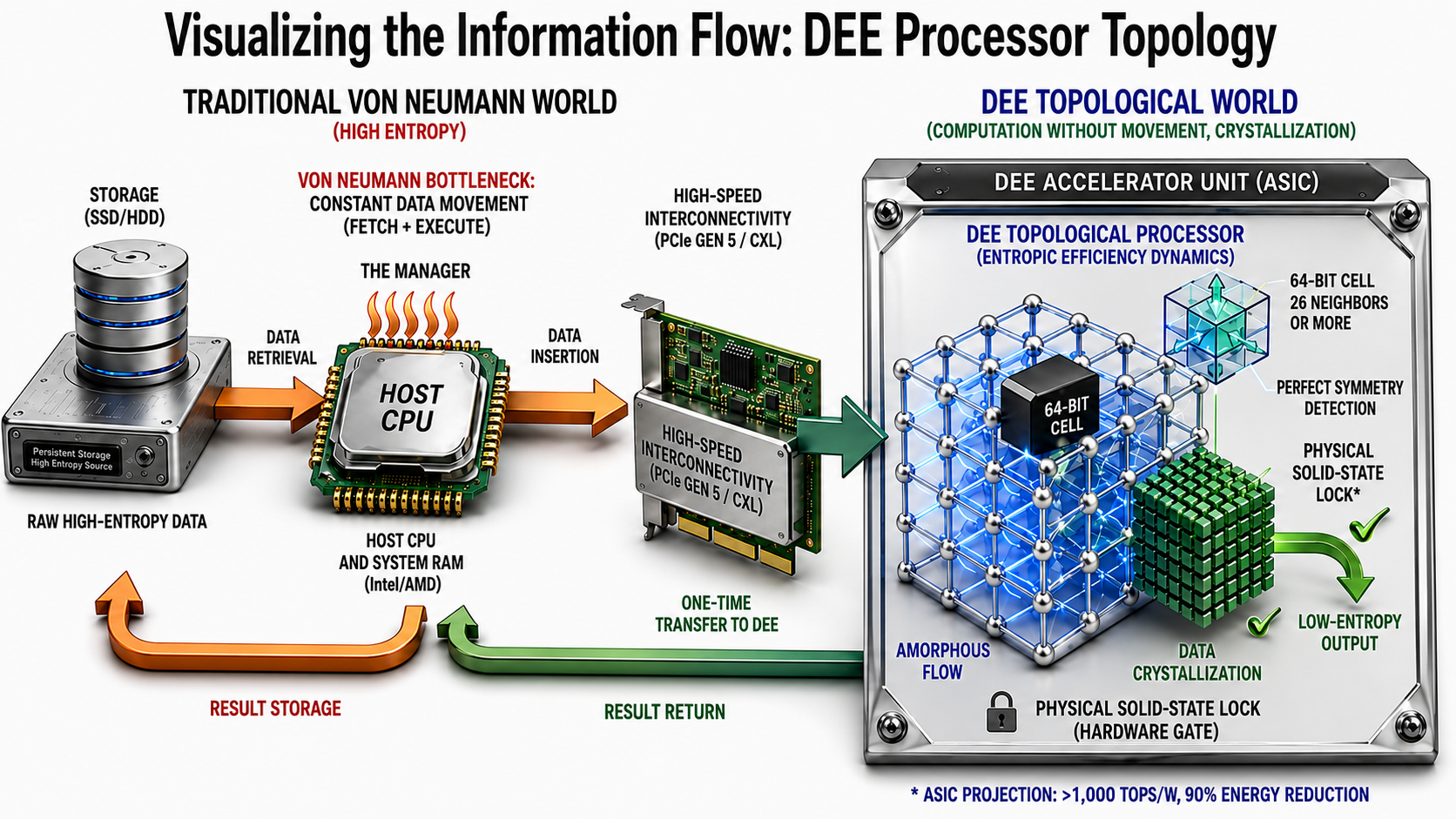
OKOZAM turns an architectural thesis into a structured technical asset, assessable and prepared for industrial integration under NDA.
Processes data directly inside memory, eliminating unnecessary transfers and enabling volumetric scalability.
Replaces centralized synchronization with asynchronous local events, reducing power consumption, heat, and scalability constraints.
Integrates high-density, low-power non-volatile memory designed for advanced 3D architectures.
Minimizes system energy expenditure in stable states, bringing operation close to extremely low levels.
Designed around existing standards and processes to facilitate evaluation, adoption, and integration.
OKOZAM's intellectual property package is articulated in four technical layers, each with a specific role within the architecture.
Analytical specification of the HfO₂ ReRAM substrate and physical model for deterministic system behavior.
RTL Verilog of the Topological Voxel, thermodynamic ALU, DEMUX tree, and Phase Lock detector.
3D topology, full neighborhood, coplanar routing, TSVs, and microbumps for volumetric integration.
DEE Boundary Scan, telemetry, PCIe Gen 5/6 integration, CXL, and communication protocols.
| Layer | IP Component | Maturity |
|---|---|---|
| L0 - Materials | Analytical specification of the HfO₂ ReRAM substrate with an optimized geometric regime. | Documented physical model. |
| L1 - Voxel Logic | RTL Verilog modules of the Topological Voxel: thermodynamic ALU, DEMUX tree, and Phase Lock detector. | Validated on Xilinx Artix-7 FPGA. |
| L2 - Interconnection | 3D topology for full neighborhood, coplanar routing, TSVs, and microbumps. | Designed for standard 3D-IC processes. |
| L3 - Host Interface | DEE Boundary Scan protocol, Sparse Matrix telemetry, PCIe Gen 5/6 integration, and CXL. | Specified and prototyped. |
OKOZAM is grounded in a proprietary theoretical framework called Entropic Efficiency Dynamics, or DEE.
Information is interpreted as a geometric property of the system.
Entropy can be directed and accumulated computationally.
Data stability emerges through vector symmetry.
Phase Lock replaces traditional writing and reduces dynamic power consumption.
OKOZAM does not compete as an incremental optimization, but as an architectural shift relative to the traditional model.
| Attribute | Traditional HPC GPUs | Wafer-Scale Accelerators | Neuromorphic | OKOZAM IP Core |
|---|---|---|---|---|
| Architecture | Synchronous Von Neumann | Distributed Von Neumann | 2D Asynchronous | Asynchronous 3D In-Memory |
| Memory | External HBM | SRAM on-die | SRAM on-die | Non-volatile HfO₂ ReRAM |
| Clock | Global GHz | Global GHz | Local | No global clock |
| Topology | 2D | 2D wafer | 2D mesh | 3D with full neighborhood |
| Idle Power | High | High | Medium | Near zero |
| Scalability | Software-bound | Wafer-bound | Mesh-bound | Native volumetric linear scaling |
Qualitative comparison of architectural positioning. Detailed technical validation is available under NDA.
Technical documentation, FPGA validation evidence, and transfer structure can be presented to strategic buyers and qualified industrial partners.
Complete the form and we will prepare the right conversation for NDA, technical validation, licensing, or industrial integration.